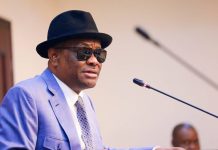
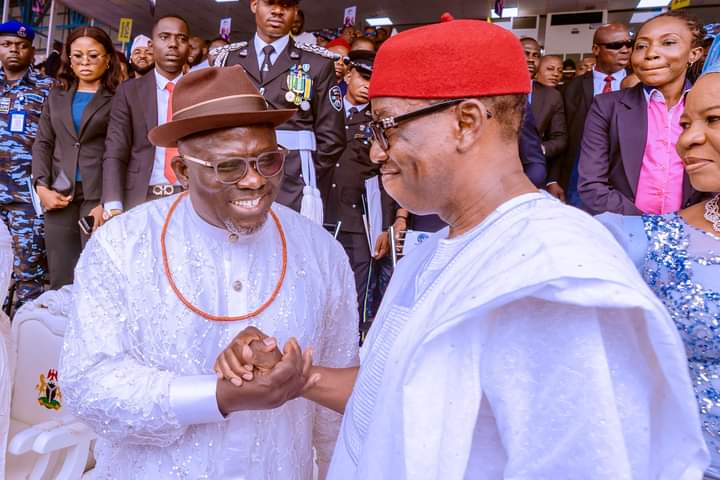
Senate Minority Leader Abba Moro has accused former Vice President Atiku Abubakar’s running mate in the 2023 presidential election, former Delta State Governor Ifeanyi Okowa, of contributing to the loss in the election.
Moro made these remarks in response to Okowa’s recent statement expressing regret over accepting the position.
On Monday, Okowa officially defected to the ruling All Progressives Congress (APC), alongside Delta State Governor Sheriff Oborevwori and the PDP structure in the state. In an interview on Arise TV, Okowa stated that he regretted his decision to join Atiku’s ticket.
Peter Obi Does Not Require Coalition to Win 2027 Election – NLC
Moro, however, described Okowa’s comments as “uncharitable.” He argued that Okowa had actively sought the vice presidential position and should not now distance himself from the consequences of that choice.
Moro also revealed that within the People’s Democratic Party (PDP), some members were dissatisfied with Okowa’s selection.
He stated that many believed there were others in the party who had contributed more to its success and were better positioned to help win the election, rather than Okowa.
“Some people were of the opinion that there were others who had contributed more to the success of the party, who were more committed and would have helped the party win the election rather than pick him,” Moro said.
He noted that Okowa’s rise through the ranks of the PDP—from senator to governor—was made possible by the platform he now appears to be disavowing.
“It’s unfortunate today that at his level, having been a senator and governor before on the platform of the PDP, I think it’s uncharitable for him to be expressing regret about being the party’s running mate. He was not forced. He asked for it, and he was given.
“With the hindsight that we have now, some of us think that the party would have won the election if another candidate—other than Okowa—had been picked as the vice-presidential candidate from the South.
“I think there was an error of judgment on the part of everybody that was involved in the choice of Okowa as the candidate,” Moro said.
He questioned Okowa’s inability to secure his home state for the PDP during the presidential election, noting that opposition parties gained significant ground in Delta despite Okowa’s stature.
“How else will you characterise this scenario—that a sitting governor, a former senator, and vice-presidential candidate couldn’t deliver his state, even to the presidential candidate?
“And to think that two out of the three senators from that state are from the opposition party, and I can tell you that one person may have won that election purely on his own merit, because of his pedigree and his contributions to the community,” he said.
On the PDP’s chances of mounting a credible challenge against President Tinubu and the APC in the 2027 elections, Moro said the political landscape remained fluid and unpredictable.
“One day in politics is like decades,” he noted, adding that things were happening so rapidly that they defy imagination and comprehension, even among seasoned political actors and that the same kind of rapid shift could work in favour of the PDP.
He pointed to recent efforts by the party’s leadership as evidence that the PDP is not crumbling, despite high-profile defections.
“Just about 72 hours ago, the chairmen of the PDP in the 36 states and the FCT met and reaffirmed their commitment to mobilising and galvanising support for the party, especially in light of what has happened in Delta State,” he said.
According to Moro, the PDP still commands deep loyalty across the country.
“There are individuals within the party whose body and soul remain committed to the PDP, and who are willing to make sacrifices and go to great lengths to rebuild the party.
“If the rebuilding effort meets the expectations for 2027, so be it. If it doesn’t, the PDP remains an integrated political brand that cuts across all segments of Nigerian society. It will not be easily broken,” he said.