
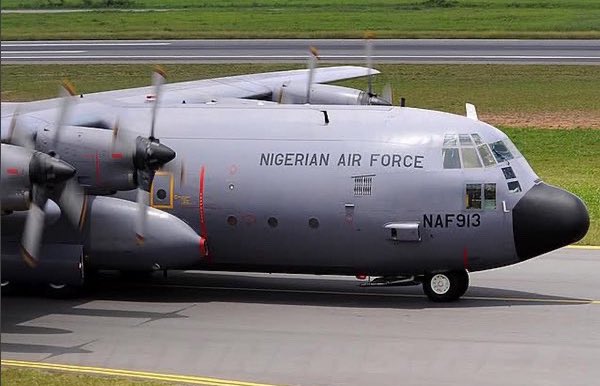
On the morning of 8 December 2025, a Nigerian Air Force C 130 Hercules lifted off from Lagos on what should have been a routine ferry mission to Portugal. But less than an hour into the flight, a technical concern detected by the crew altered the aircraft’s course and set off a minor diplomatic ripple across West Africa.
By afternoon, the same aircraft had become the subject of two competing narratives: one from Abuja, which described a precautionary safety manoeuvre, and another from Ouagadougou, which claimed a forced landing due to airspace violation. The truth, as with most aviation incidents, lies somewhere between the altitude of protocol and the fog of political interpretation.
A Call Made in the Cockpit
According to the Nigerian Air Force, the crew noticed the technical issue shortly after leaving Lagos. With ferry missions often covering long distances over varying airspace jurisdictions, the standard procedure is simple: find the nearest available runway and land safely.
For the C 130, that nearest runway was in Bobo Dioulasso, Burkina Faso.
Galatasaray Seek Redemption as Osimhen Returns to Light the Fire
In a calm, procedural explanation, Air Commodore Ehimen Ejodame, the NAF spokesperson, emphasised that the diversion adhered strictly to international aviation safety protocols.
“The crew observed a technical concern which necessitated a precautionary landing,” he said. “The NAF crew is safe and has received cordial treatment from the host authorities. This was purely an operational safety decision.”
To reinforce the point, NAF noted that the crew—11 personnel—were secure, comfortable and in contact with Nigerian authorities. Plans to resume the Portugal mission, the Air Force added, were already underway.
But across the border in Burkina Faso, a different framing was emerging.
Burkina Faso’s Version: A Breach or a Miscommunication?
The state run Agence d’Information du Burkina published a statement from the Confederation of Sahel States claiming that the Nigerian aircraft had “violated airspace” and was “forced to land.”
The language was noticeably sharper, almost suggesting an intrusion rather than an emergency descent.
In a region where military governments are increasingly assertive about sovereignty and territorial protection, the framing was not surprising. But aviation experts quickly noted that even in cases of distress or precaution, foreign military aircraft entering a neighbouring airspace without prior clearance is not unusual.
“Aircraft in distress are given priority everywhere in the world,” one aviation analyst observed. “Once the pilot declares a safety precaution or technical concern, the nearest runway becomes a safe zone. Politics only enters the chat after the landing.”
Reading Between the Diplomatic Lines
That political undertone is what gave the story momentum. Nigeria and Burkina Faso currently sit on opposite ends of several regional political debates, especially with the Sahel States bloc (Burkina Faso, Mali, Niger) entrenched in a complex relationship with ECOWAS. Any cross border military movement — even in an aircraft emergency — is instantly magnified.
But witnesses at the Bobo Dioulasso airfield painted a calmer picture. The Nigerian crew reportedly received hospitality, not hostility, from Burkinabe authorities. There was no confrontation, no detainment, no standoff — merely standard reception for an aircraft making an emergency landing.
Kanu to spend Christmas, New Year in Sokoto Prison as Court rejects transfer request
By evening, it became clear that the initial rhetoric from the Sahel Confederation was more political signalling than a description of events on the runway.
Understanding the Aircraft — and the Stakes
The C 130 Hercules is a workhorse of global air forces, relied upon for transport, humanitarian missions and logistics. Any technical concern on such a mission — whether electrical, pressurisation or engine related — demands caution.
“It’s never worth pushing a military aircraft with a suspected fault over long distance,” a retired Nigerian pilot explained. “The crew did the right thing. You always choose the nearest safe landing option.”
In aviation, accuracy matters, but safety matters more.
Beyond the Headlines: What Really Happened
The reality is far less dramatic than the political spin:
- A technical concern triggered a diversion
- The aircraft landed at the nearest safe airfield
- The crew was safe and well treated
- Plans to resume the mission were never suspended
- No bilateral dispute escalated behind the scenes
Yet the incident revealed something deeper:
In West Africa’s current climate, even a routine aviation precaution can be reframed into a geopolitical statement.
Why This Matters
The C 130 diversion is not just a story about an aircraft — it reflects the region’s fragile diplomatic dynamics. It shows how quickly technical issues can be politicised, how military sensitivities shape public narratives, and how essential it is for air forces to communicate early and clearly during cross border incidents.
For Nigeria, the response was calm and procedural.
For Burkina Faso, the framing was protective and assertive.
For the region, the event is a reminder that aviation and diplomacy are increasingly intertwined.
In the end, the sky was not the battleground some assumed.
It was simply the backdrop to a misunderstanding shaped by timing, tension and the need to project strength.
And above all, the crew of the C 130 — the humans inside the headline — are safe, preparing to lift off once again, this time with the technical issue resolved and the political turbulence behind them.