The Rivers political volcano, long rumbling beneath the surface, flared again this week. And it all began with one question: how did a governor calling for peace end up accused of plotting a fresh crisis?
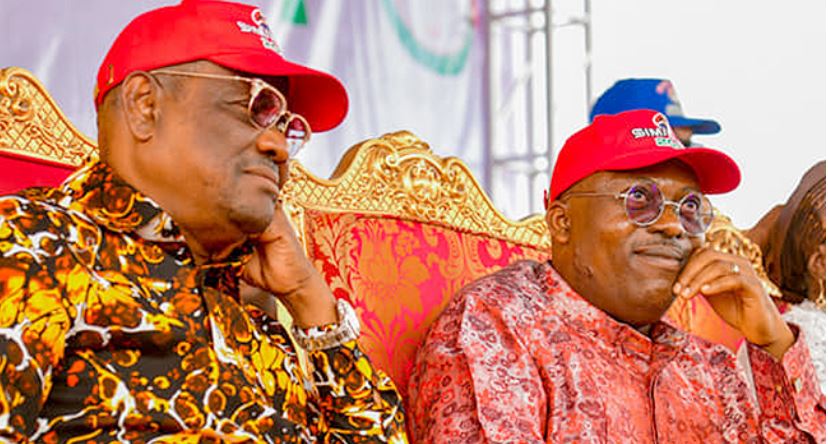
On Wednesday, Governor Siminalayi Fubara stood before a crowd at a project inauguration and made an appeal that sounded almost plaintive. He wanted peace, he said. He was ready to meet the lawmakers loyal to his estranged political benefactor, Nyesom Wike. If only the Minister of the Federal Capital Territory would grant audience and broker the long-awaited reconciliation.
But barely 24 hours later, the Speaker of the Rivers State House of Assembly, Martin Amaewhule, detonated a political counter-narrative that upended Fubara’s version—and reignited tensions many hoped had been buried under President Tinubu’s intervention.
Amaewhule, flanked by lawmakers who once formed the backbone of the Assembly majority, stepped before reporters with a familiar complaint: the governor, he said, was lying. And worse—setting Rivers up for yet another round of political turmoil.
How the Story Split in Two
According to the Speaker, the governor’s public lament about stalled peace talks was not only misleading—it was “condemnable.” Amaewhule insisted that Wike had convened multiple meetings in Abuja and Port Harcourt, all attended by both camps. If the governor was still waiting for reconciliation, Amaewhule argued, it was because Fubara had chosen to wait, not because lawmakers were unavailable.
Malami in the Net: Ex-AGF Detained Over Terrorism Financing, Abacha loot, Others
The Speaker rattled off locations, dates, even the presence of Rivers elders. His point was unmistakable: peace talks had happened, but goodwill had not followed.
Inside that critique was a deeper allegation—one that strikes at the heart of governance. Amaewhule accused the governor of shutting out the Assembly, refusing to present the 2025 budget, and spending state funds “from his front pocket” without legislative approval.
His most explosive claim landed hard: over N600bn reportedly left in the state’s account after the emergency administration was lifted had been placed at the governor’s discretion—and misused.
To the lawmakers, that was not just poor leadership. It was a warning sign that the governor was preparing conditions for another institutional confrontation.
How a Fragile Peace May Be Crumbling Again
In Rivers, political conflict never really ends; it simply mutates, pauses, and resumes under new circumstances.
Fubara’s camp frames the moment as a struggle for autonomy—an attempt to shed the shadow of his predecessor. Amaewhule’s bloc sees it as governance gone rogue, with the Assembly boxed out and institutions weakened.
But beneath the accusations is the real unease: how long can Rivers survive repeated power struggles without the political centre collapsing again?
The Speaker’s language was unmistakably confrontational. He accused the governor of indolence, divisiveness, and using state funds as political ammunition. He dismissed Fubara’s remarks about Wike as falsehoods designed to manipulate public sympathy.
His lawmakers punctuated the presser with a dramatic chorus: “Members, are you for sale? No. Not at all!” The message was unmistakable—loyalty, not compromise, is the battle line.
How the People Are Caught in the Middle
What suffers most in this political tug-of-war are the very things Rivers residents care about: governance, schools, budgets, development. Even as Amaewhule spoke, he pointed to education decay as an example of where disagreements had created vacuum.
All of it lands as a reminder: this feud is not just personal—it is structural.
The Assembly insists it is committed to peace and aligned with President Tinubu’s Renewed Hope agenda. But lawmakers say the governor’s actions are dragging the state back to instability.
Kanu to spend Christmas, New Year in Sokoto Prison as Court rejects transfer request
For a region that has lived through impeachments, burnt assembly chambers, emergency administrations, and bitter court battles, the fear is simple: is Rivers headed toward another dangerous cycle?
How This Ends—and Why It Matters
The return of political tension in Rivers is not merely a local skirmish. It touches Abuja, tests Tinubu’s earlier peace deal, and potentially shapes the political architecture of the South-South going into 2027.
One storyline says the governor is fighting for independence. Another says he is rewriting the rulebook in ways that threaten institutional balance.
But until both sides step beyond press statements and return to genuine dialogue, Rivers will remain what it has been for months: a state where governance is overshadowed by feud, and where the next crisis is always one speech away.