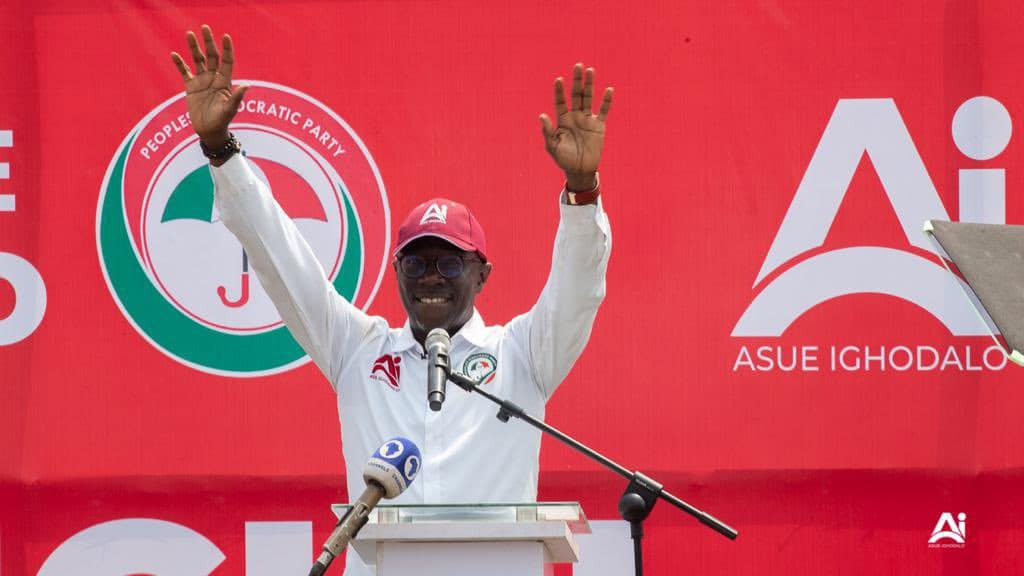
The Supreme Court on Wednesday reserved judgment in the appeal filed by the Peoples Democratic Party’s (PDP) candidate, Asue Ighodalo, challenging the outcome of the 21 September 2024 governorship election in Edo State.
The apex court reached this decision after hearing arguments from both sides.
The appeal contests the result declared by the Independent National Electoral Commission (INEC), which announced Monday Okpebholo of the All Progressives Congress (APC) as the winner of the election.
The case was heard by a five-member panel of justices, led by Justice Garba Lawal.
Ighodalo’s legal team, headed by Senior Advocate of Nigeria Ken Mozia, urged the court to overturn the rulings of the lower courts that had upheld INEC’s declaration of Okpebholo as the winner.
On 29 May 2025, the Court of Appeal in Abuja affirmed the judgment of the Edo State Governorship Election Petition Tribunal.
Both courts dismissed Ighodalo’s petition, describing it as lacking merit.
On 2 April 2025, a three-member panel of the tribunal, chaired by Justice Wilfred Kpochi, dismissed the petition filed by the PDP and Ighodalo, citing the petitioners’ failure to substantiate claims of over-voting and electoral irregularities.
The petition, marked EPT/ED/GOV/02/2024, alleged that Okpebholo did not secure the highest number of lawful votes and that the election was marred by widespread irregularities, over-voting, and breaches of the Electoral Act.
The PDP and Ighodalo claimed the election involved incorrect collation of results, errors in vote computation across 765 polling units, and a failure by INEC to serialise ballot papers or pre-record sensitive materials, which they argued facilitated electoral malpractice favouring the APC and its candidate.
During the trial, the petitioners called 19 witnesses and subpoenaed a Senior Technical Officer from INEC’s ICT department, who presented 154 BVAS machines from 133 polling units to support allegations of over-voting.
INEC did not present any witnesses.
Okpebholo called one witness, while the APC presented four.
While the PDP sought the tribunal’s annulment of the election based on the evidence, the respondents contended that the petition lacked merit.
They argued that Ighodalo failed to prove, beyond reasonable doubt, that he had won the election or that there was significant non-compliance with electoral law.
Justice Kpochi, delivering the tribunal’s judgment, stated: “We hold that the petitioners’ failure to call polling unit agents, presiding officers, or other registered voters was fatal to the case.
“It remains settled law that documents do not speak for themselves. A petitioner must prove their evidence. Allegations of non-compliance must be substantiated.
“The BVAS machines were clearly abandoned and remained dormant. None of the witnesses could attest to the BVAS machines’ operation. The machines were not demonstrated to substantiate the allegations of over-voting.
EFCC Detains Top NNPC Officials Over $7.2bn Refinery Rehabilitation Scam
“All documentary evidence tendered by the petitioners to prove over-voting falls short of legal requirements. The law requires petitioners to call witnesses to link the evidence presented.”
Regarding the petitioners’ claims that INEC failed to comply with electoral guidelines, Justice Kpochi ruled: “The petitioners failed to prove that the first defendant did not comply with the provisions of the Electoral Act or INEC’s rules of conduct as required by law.”
On the claim concerning missing serial numbers on ballot papers, the tribunal observed, “There are figures here.”
The court also rejected allegations of a lack of prior recording of materials used during the poll.
In the official result announced by INEC, Okpebholo polled 291,667 votes, while Ighodalo came second with 247,655 votes.
At Wednesday’s hearing, INEC was represented by Kanu Agabi, who urged the Supreme Court to dismiss the appeal.
Agabi contended that the PDP and Ighodalo had declared the election illegal and, therefore, could not seek to be declared winners of the same election.