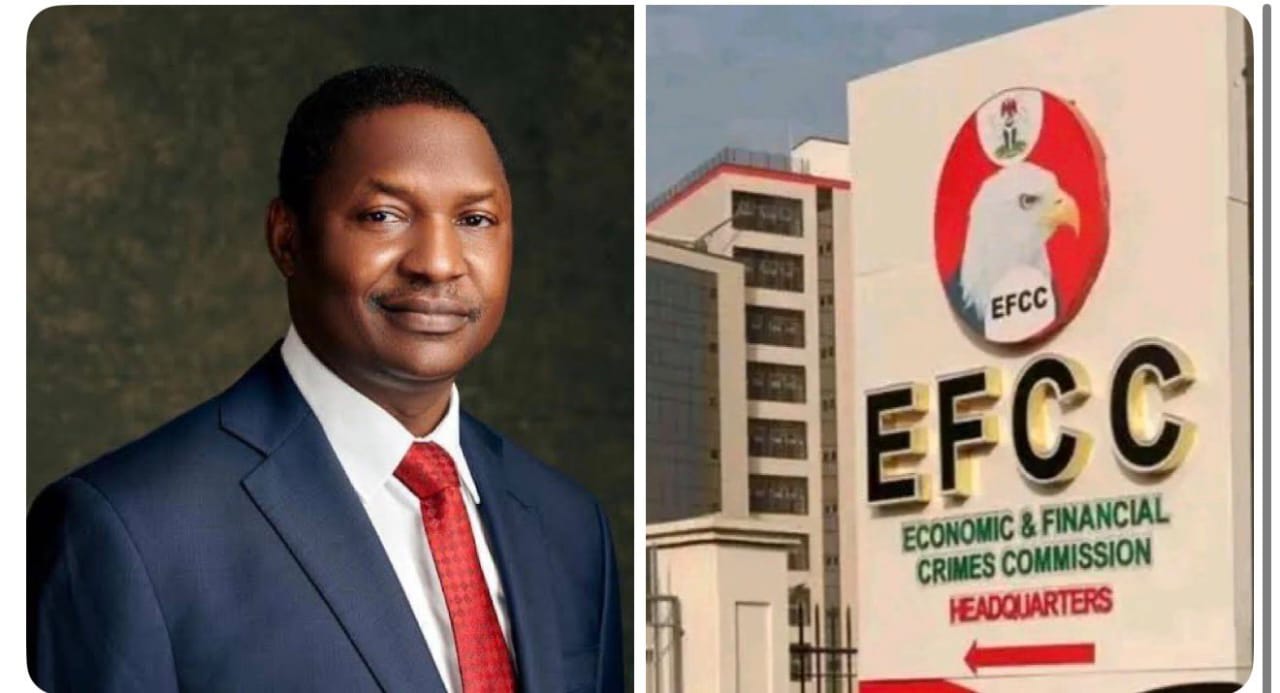
Immediate past Attorney General of the Federation and Minister of Justice, Abubakar Malami (SAN), has been dragged before the courts in what is shaping up as one of the most far-reaching corruption cases involving a former top official of the Muhammadu Buhari administration.
The Economic and Financial Crimes Commission has filed a 16 count charge against Malami, accusing him of laundering billions of naira through an elaborate web of property acquisitions and financial transactions carried out largely during his eight years in office between 2015 and 2023, reports The Nation.
According to the charge sheet dated December 23, 2025, Malami is standing trial alongside his son, Abdulaziz Malami, and Hajia Bashir Asabe, an employee of Rahamaniyya Properties Limited. The EFCC alleges that the trio conspired to conceal and disguise proceeds of unlawful activities by acquiring choice properties across Abuja, Kebbi and Kano.
Intelligence vs Diplomacy: Why U.S. Spy Reports Still See Putin Pushing Beyond Ukraine
At the heart of the case is an allegation that Malami laundered about N9 billion to acquire no fewer than 30 houses, with the properties collectively valued at an estimated N212.8 billion. Investigators say most of the acquisitions occurred while he was serving as the nation’s chief law officer.
The anti graft agency is prosecuting the case under various provisions of the Money Laundering Prohibition Act of 2011 as amended, as well as the Money Laundering Prevention and Prohibition Act of 2022. The charges include allegations of conspiracy, concealment of proceeds of crime, indirect acquisition of properties with illicit funds and using corporate entities as fronts to launder money.
One of the counts alleges that between July 2022 and June 2025, Malami and his son procured Metropolitan Auto Tech Limited to conceal over N1 billion lodged in a Sterling Bank account, funds the EFCC says were proceeds of unlawful activity. Other counts detail transactions involving hundreds of millions of naira allegedly paid for luxury properties in Maitama, Asokoro, Jabi, Garki and Gwarimpa in Abuja, as well as assets in Kebbi and Kano.
The EFCC further claims that some of the funds were used as cash collateral for bank loans, while others were routed through hotel and real estate companies to obscure their origin. Properties mentioned in the charge include luxury duplexes, hotels, plazas, hectares of land and high value residential buildings in prime locations.
In a move that raises the stakes, the commission is also considering invoking the Non Conviction Based Asset Forfeiture provisions of its Establishment Act. If activated, the EFCC has a 14 day window to publish notices inviting interested parties to show cause why the assets should not be forfeited to the Federal Government.
The trial is expected to take place at the Federal High Court in Abuja, with the EFCC awaiting the assignment of a hearing date. In what insiders describe as a legal heavyweight bout, the prosecution team is led by Chief Jibrin Okutepa (SAN) and Ekene Iheanacho (SAN), supported by 14 other lawyers. At least 10 witnesses have already been frontloaded in line with the Administration of Criminal Justice Act.
Why the PDP Is Bleeding in Rivers and How the APC Is Cashing In
As of Tuesday, Malami was still in EFCC custody and had not issued an official response to the charges. His last public comment was a statement calling on the EFCC chairman, Ola Olukoyede, to recuse himself from the case.
The unfolding prosecution places a sharp spotlight on one of the most powerful figures of the last administration and could become a defining test of Nigeria’s post Buhari anti corruption drive, especially given Malami’s former role as the country’s chief legal officer and gatekeeper of federal prosecutions.