

Africa is experiencing its most turbulent political period in two decades as soldiers increasingly seize power, test democratic institutions, and reshape geopolitical alliances. Since 2020, at least 10 African countries have experienced attempted or successful coups—signaling a dangerous return to military politics reminiscent of the 1960s–1980s.
Below is an elaborate timeline, enriched with context and analysis, showing how the continent arrived at this new era of political instability.
Mali — August 2020 & May 2021
The Coup Cycle That Sparked a Regional Domino Effect
Mali became the first in West Africa’s recent wave of military takeovers. In August 2020, Colonel Assimi Goïta overthrew President Ibrahim Boubacar Keïta amid mass protests over corruption and insecurity.
A transitional government was formed, with Bah Ndaw (civilian) as President and Goïta as Vice President.
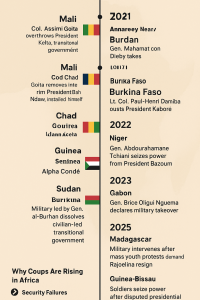
But in May 2021, Goïta staged a second coup—this time removing Ndaw and installing himself as President. Mali’s repeated instability inspired similar actions across the Sahel.
Chad — April 2021
A Dynasty Continues in Khaki
When President Idriss Déby died on the battlefield after 30 years in power, his son, General Mahamat Idriss Déby, bypassed constitutional order and assumed control.
Instead of the Speaker of Parliament taking over (as required by law), the military declared Déby as “transitional leader.”
Benin Coup Collapses After Nigeria Steps In — What Really Happened
The international community widely viewed it as a palace coup but accepted it to avoid further chaos in the volatile Lake Chad region.
Guinea — September 2021
Alpha Condé Overthrown After Constitutional Manipulation
Eleven years into his rule—and after controversially amending the constitution to run for a third term—President Alpha Condé was removed by Colonel Mamady Doumbouya, leader of an elite special forces unit.
Doumbouya accused Condé of corruption and bad governance, promising a new political order.
Sudan — October 2021
The Collapse of a Fragile Civil-Military Pact
Sudan had been attempting a civilian transition after the fall of Omar al-Bashir in 2019. But in 2021, the military—led by General Abdel Fattah al-Burhan—disrupted the process, detained civilian Prime Minister Abdalla Hamdok, and took power.
Sudan has since spiraled into civil conflict, with rival generals waging a deadly war that gutted the nation.
Burkina Faso — January 2022 & September 2022
Two Coups in One Year Highlight Security Fractures
In January 2022, President Roch Kaboré was ousted by Lt. Col. Paul-Henri Sandaogo Damiba, who accused the government of failing to stop jihadist attacks.
Eight months later, Damiba himself was overthrown by Captain Ibrahim Traoré, a 34-year-old artillery officer who became Africa’s youngest leader.
Traoré has since aligned with military-run Mali and Niger, forming a new “Alliance of Sahel States” that distances itself from France and ECOWAS.
Niger — July 2023
A Shock Coup Against a Pro-Democracy Symbol
General Abdourahamane Tchiani, head of the presidential guard, toppled President Mohamed Bazoum—one of West Africa’s few remaining democratically elected leaders.
The coup triggered severe ECOWAS sanctions and produced a dramatic rupture in regional diplomacy. Niger then expelled French forces and deepened security ties with Russia-aligned groups.
Gabon — August 2023
Anger Over Dynasty and Election Fraud Sparks Military Action
Hours after President Ali Bongo was declared winner of a controversial election, soldiers appeared on state TV and nullified the results. Led by Gen. Brice Oligui Nguema, the military accused the Bongo family of corruption and mismanagement after nearly 60 years of dynastic rule.
The coup was widely celebrated in Gabon, contrasting sharply with international condemnation.
Madagascar — October 2025
Youth Protests Lead to Military Intervention
Mass youth-led protests demanding the resignation of former President Andry Rajoelina escalated into unrest. Taking advantage of the chaos, the military stepped in and took control, citing the need to “restore order.”
The coup highlighted Madagascar’s long-standing political fragility, where military actors often influence transitions.
Guinea-Bissau — November 2025
A Country With Nine Coups Adds Another to Its Record
After a disputed presidential election, soldiers seized power once again. Guinea-Bissau—historically one of Africa’s most coup-prone states—returned to military rule as rival political figures contested election results.
The instability underscored the deep ethnic, political, and military fractures that have plagued the tiny West African nation since independence.
Benin — December 2025 (Failed Coup Attempt)
A Near-Miss in a Country Long Considered Stable
Benin was jolted by a failed coup attempt led by Lt. Col. Pascal Tigri, who seized the state TV station and declared President Patrice Talon removed.
But loyalist troops, backed by rapid Nigerian intervention under ECOWAS protocols, foiled the coup within hours.
Confusion as Niger Govt, CAN Say No Confirmation of 100 Pupils’ Release
The incident raised alarms: if even stable democracies like Benin are now targets, the coup contagion may be spreading.
Why Are Coups Rising Again in Africa?
Analysts cite several interlinked factors:
• Security failures
States battling jihadists and insurgents—Mali, Burkina Faso, Niger—often see the military step in.
• Frustration with long-ruling elites
Gabon and Guinea saw coups after decades of entrenched leadership.
• Constitutional manipulation
Leaders extending or bending term limits have triggered military backlash.
• Public disillusionment with democracy
Poor governance, poverty, and corruption make citizens receptive to alternative leadership — even military rulers.
• Declining Western influence & rising Russia-China presence
Political realignment in the Sahel has encouraged anti-Western sentiment and military adventurism.
The Big Picture: An Era of Democratic Reversal
Between 1960 and 2000, Africa saw over 80 coups. After 2000, democratization improved, and coups sharply declined.
But since 2020, the trend has reversed dramatically — leading many political scientists to call it Africa’s New Coup Wave.
While some coups enjoy temporary public support, history shows they rarely deliver stability or economic progress.