
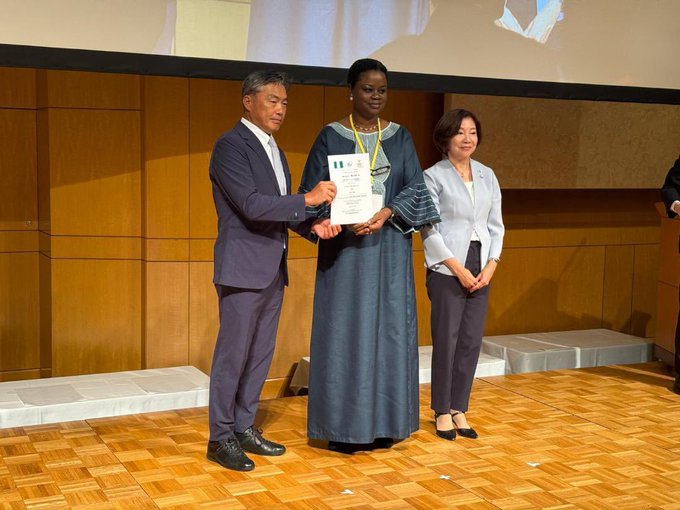
In a significant move to strengthen bilateral relations and address domestic demographic challenges, the Japanese government has designated the city of Kisarazu as the official hometown for Nigerians seeking to live and work in Japan.
The announcement was made on Thursday during a side event at the 9th Tokyo International Conference on African Development (TICAD9), as part of Japan’s broader strategy to foster cultural diplomacy, promote economic cooperation, and enhance workforce productivity.
Under this new initiative, a special visa category will be introduced for highly skilled, innovative, and talented Nigerian professionals, allowing them to live and work in Kisarazu. Additionally, artisans and blue-collar workers from Nigeria who are willing to upskill will also benefit from the programme, reflecting Japan’s need for labour to support its ageing population and shrinking workforce.
Falana to APC, PDP: Prove You’re Not Terrorist Organisations
The move also aims to revitalise regional economies. Kisarazu, located in Chiba Prefecture, was previously the host city for Nigeria’s contingent during the 2020 Tokyo Olympic Games, a relationship that laid the foundation for this deeper collaboration.
Nigeria’s Charge d’Affaires and Acting Ambassador to Japan, Mrs Florence Akinyemi Adeseke, alongside Mr Yoshikuni Watanabe, the Mayor of Kisarazu, received the official certificate recognising the city as Nigeria’s hometown in Japan. The certificate was presented in a formal ceremony hosted by the Japan International Cooperation Agency (JICA).
Similar hometown designations were also made for three other African countries: Nagai (Tanzania), Sanjo (Ghana), and Imabari (Mozambique). According to JICA, the aim is to connect Japanese municipalities with long-standing relationships with African nations to foster manpower development, mutual exchange, and long-term economic collaboration.
Speaking at the TICAD9 summit, Japanese Prime Minister Shigeru Ishiba unveiled $5.5 billion in new investment commitments for Africa and highlighted Japan’s shift toward co-creation with the continent, driven by mutual understanding and community-led solutions.
“Japan is providing various cooperation and support for Africa. But first of all, Japan needs to know more about Africa. So, in creating solutions together, this co-creation at the TICAD 9, we focus on three important areas: private sector-led sustainable growth, Youth and Women, and Regional integration and connectivity within and beyond Africa,” the Prime Minister said.
While acknowledging Japan’s demographic and agricultural challenges, he appealed to African nations to collaborate with Japan in developing practical, human-centred solutions.
“Japan needs to know more about Africa,” he said. “We appeal to African countries to assist Japan as it grapples with the challenges of a declining population and shrinking agricultural land.”
Local authorities in Kisarazu expressed optimism that the partnership with Nigeria will help attract new residents, stimulate cultural exchange, and serve as a model for regional revitalisation across the country.
The designation of Kisarazu as a hometown for Nigerians is expected to serve as a bridge for long-term cooperation in education, training, employment, and social integration — laying a solid foundation for sustainable and inclusive development between the two nations.