
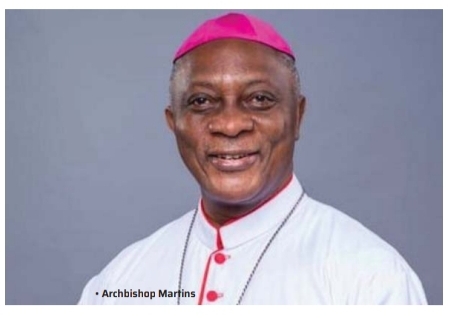
The Archbishop of the Catholic Archdiocese of Lagos, Most Rev. Dr Alfred Adewale Martins, has called on governments, industries and other stakeholders to adopt policies that guarantee universal access to clean water, proper sanitation and safe, nutritious food, warning that environmental degradation threatens both human wellbeing and the future of creation.
Archbishop Martins made the call in his special message for the 2026 Season of Creation, urging Nigerians and people of goodwill to recognise the close relationship between environmental protection, human dignity and the wellbeing of vulnerable communities.
He also called on governments, industries, farmers and local authorities to protect water sources, improve waste disposal practices and take decisive action against pollution in all its forms. He urged churches, mosques and other faith based organisations to support environmental initiatives, including greening projects and programmes that equip communities to grow their own food.
The Archbishop said the 2026 Season of Creation, which begins on September 1 and ends on October 4, the Feast of St Francis of Assisi, provides an opportunity for Christians across denominations to move beyond prayers and reflections to practical action in protecting the environment.
According to him, this year’s theme, “Immersion in Living Water,” is a reminder that water is essential to life and must be protected as a shared resource. He urged stakeholders to advocate universal access to clean water and adequate sanitation in homes, schools, healthcare facilities, churches and mosques.
“We must advocate for universal access to clean water and proper sanitation in our communities, homes, schools, health care facilities, churches, and mosques,” he said.
Martins also called for stronger environmental education, saying parents, catechists, clerics and faith communities should equip people with both scientific knowledge and ethical values needed to develop a healthier relationship with nature. He argued that environmental protection should not be treated solely as a technical or governmental responsibility but as a moral obligation shared by individuals and communities.
The Archbishop drew inspiration from the teachings and example of St Francis of Assisi, whom he described as the world’s foremost ecologist, noting that the saint’s virtues of poverty, humility, love and peace remain relevant to the environmental and social challenges confronting the world. The 2026 Season of Creation also coincides with the Jubilee Year of St Francis of Assisi, running from January 2026 to January 2027 to commemorate 800 years since his death.
He said the message of Pope Leo XIV further reinforces the need for Christians and humanity at large to rethink their relationship with creation. According to Martins, the Pope has emphasised that St Francis’s message of peace, humility, simplicity and environmental responsibility remains particularly relevant in a world facing division, materialism and growing ecological challenges.
Martins further referenced the legacy of the late Pope Francis and his 2015 encyclical, Laudato Si’, which placed environmental protection at the centre of Catholic social teaching. He noted that the document’s recognition that the “cry of the earth” and the “cry of the poor” are inseparable should guide efforts to address poverty, pollution, climate challenges and environmental degradation.
He warned against an approach that treats nature simply as a resource for exploitation, calling instead for a shift from “mindless exploitation to care of the earth” and from short term economic gains to long term sustainability.
“We must see a shift from mindless exploitation to care of the earth, and from short-term gain to long-term flourishing, thereby rethinking our values, economic systems, and priorities,” he said.
The Archbishop maintained that human prosperity cannot be separated from the health of the natural environment, stressing that communities cannot genuinely flourish while their water sources are polluted, their surroundings are degraded and access to basic environmental services remains limited.
He therefore urged Nigerians to become active stewards of the environment by taking responsibility for their surroundings, reducing pollution and supporting initiatives that promote sustainable living.
“We must recognise the fact that our own flourishing is intertwined with the healing of creation, and one cannot be separated from the other,” Martins said.
He added: “Let us all become Living Waters of God’s Peace, refreshing our wounded world.”
The Season of Creation is a worldwide ecumenical period dedicated to prayer, reflection and action for the protection of the earth, bringing together Christians across denominations from September 1 to October 4 each year. For 2026, the observance places particular emphasis on water, renewal and humanity’s responsibility to care for the earth as a common home.