
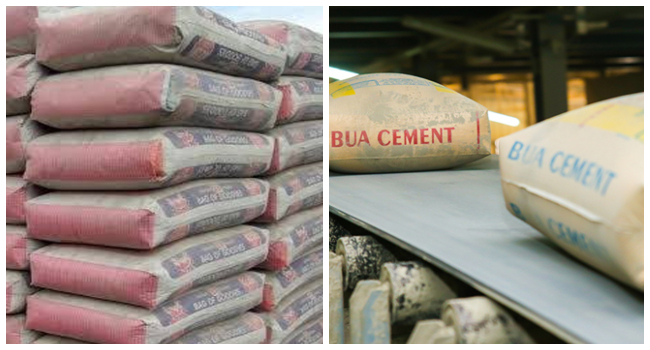
The Federal Competition and Consumer Protection Commission has opened an investigation into Nigeria’s cement industry over possible price manipulation, after a three month cross border study raised questions about why cement prices continue to rise despite the country’s substantial production capacity and abundant limestone deposits.
The FCCPC said its preliminary findings suggested possible anti competitive practices in the sector and announced that it had issued Notices of Commencement of Investigation and Summons to Produce to key industry players.
The investigation is examining whether prevailing cement prices are justified by legitimate production and distribution costs or whether coordinated conduct, abuse of market power, restrictions on domestic supply and anti competitive distribution practices may be contributing to the high prices.
The Commission’s Anticompetitive Practices Department conducted the study in response to widespread complaints over the cost of cement. The assessment compared Nigeria with Kenya, Tanzania, South Africa, Egypt, Morocco, Algeria and Togo.
Former Cambridge Professor Jason Arday Found Dead Days After Resigning Amid Plagiarism Row
Kaduna Varsity Loses Over 200 lecturers as ASUU Issues Strike Ultimatum
According to the FCCPC, Nigeria has estimated installed cement production capacity of between 60 million and 65 million metric tonnes annually, compared with domestic consumption of about 25 million to 30 million tonnes.
Despite the reported excess capacity and Nigeria’s position as a net exporter of cement to neighbouring countries, domestic prices have continued to climb.
The Commission said its market intelligence showed that a 50kg bag of cement, which sold for between N9,300 and N9,700 in January, rose to between N10,500 and N13,000 by mid year. By July, prices of between N13,000 and N15,000 were reported in some parts of the country.
The price disparity was also evident when Nigeria was compared with other African markets.
In Kenya, where the population is about 58.6 million and cement demand was estimated at 9.3 million metric tonnes in 2025, the FCCPC said a 50kg bag sold for about $5.40, equivalent to approximately N7,344.
In Tanzania, with a population of about 66.3 million and similar estimated cement demand, the same quantity sold for about $4.80, or N6,528.
Even in Togo, a country which the Commission said has no limestone deposits, cement sold for about $6.75, equivalent to approximately N9,180 per bag.
The findings have raised questions about why Nigeria’s significant raw material endowment and production capacity have not translated into lower domestic prices.
“Of particular concern to the commission is that this level of production capacity has not resulted in the downward pressure on domestic prices that might ordinarily be expected in a competitive market with substantial excess capacity,” the FCCPC said.
However, the Commission acknowledged that cement manufacturers had identified several legitimate cost pressures, including energy costs, the depreciation of the naira and its impact on imported machinery and spare parts, as well as transportation and logistics.
The FCCPC said it was testing those explanations against verified information on production costs, pricing, capacity utilisation and wider market conditions.
“The weight of preliminary findings provides sufficient grounds for the investigation to continue,” it said.
The investigation will therefore seek to establish whether the high prices are primarily the result of legitimate cost pressures or whether market practices are contributing to the price increases.
The FCCPC said the investigation would examine possible coordinated conduct, abuse of market power, restriction of domestic supply and anti competitive distribution practices.
It has consequently demanded information from key industry players covering pricing methodologies, production, capacity utilisation, exports and commercial relationships.
The Commission’s Executive Vice Chairman and Chief Executive Officer, Tunji Bello, said the investigation was necessary because cement plays a critical role in the Nigerian economy.
“Cement occupies a strategic place in the Nigerian economy. Its price affects the cost of building a home, developing commercial property, delivering public infrastructure and, ultimately, the cost of doing business,” Bello said.
He stressed that the probe was not intended to dictate how companies should operate or prevent legitimate profits.
“Businesses are entitled to make legitimate commercial decisions and earn returns on their investments. Competition law does not prevent that,” he said.
According to Bello, the Commission’s responsibility is to ensure that prices, output and other market outcomes are determined by genuine competition rather than unlawful conduct that restricts competition.
While the FCCPC’s findings have placed the pricing practices of cement manufacturers under scrutiny, business leaders and economists said the factors driving cement prices in Nigeria are more complicated.
Wike Closes Secretariat of Dissolved Committee on Sale of FG Houses in FCT
Chairman of the Lagos Chamber of Commerce and Industry Construction Group, Soji Adeniji, said his experience with a recent project abroad reinforced concerns about Nigeria’s comparatively high cement prices.
He said a friend involved in a construction project in Canada had considered importing cement from Nigeria, but calculations showed that Nigerian cement was not sufficiently competitive.
According to Adeniji, Turkey and some East African markets eventually emerged as more price friendly options.
He, however, argued that the question was not simply whether cement was expensive, but what was responsible for the high cost along the production and distribution chain.
Adeniji pointed to logistics, infrastructure, taxation and other business costs as possible contributors.
He also questioned claims that rainfall and access to limestone were responsible for recent supply constraints, noting that production conditions had not necessarily justified the reported scarcity.
He said the government needed to examine the entire production chain, from limestone extraction to manufacturing, transportation and distribution.
Taxation could also be contributing to the pressure, he added, citing concerns about double taxation and the wider tax regime facing manufacturers.
Professor of Economics and Public Policy at the University of Uyo, Akpan Ekpo, also suggested that supply and demand dynamics could be contributing to the situation.
He said the housing sector was a crucial part of investment and that the government needed to examine whether supply was adequately responding to demand.
The wider challenge, however, extends beyond the price of cement itself.
Higher cement prices feed directly into the cost of housing, commercial construction and public infrastructure, putting additional pressure on developers and households already facing high construction costs.
Industry experts have therefore called for measures to increase supply, improve logistics and encourage the development of alternative materials that can reduce dependence on cement in concrete production.
For the FCCPC, the immediate task is to establish whether the current price levels can be justified by genuine market conditions.
The Commission said its investigation would determine whether the reported price increases are the result of legitimate commercial costs or whether anti competitive practices are playing a role.
Until that investigation is concluded, the preliminary findings do not amount to a final determination of wrongdoing by any cement manufacturer.
But the probe has brought a central question in Nigeria’s construction industry back into sharp focus: why does cement remain so expensive in a country with vast limestone deposits, substantial production capacity and enough output to export to neighbouring countries?