
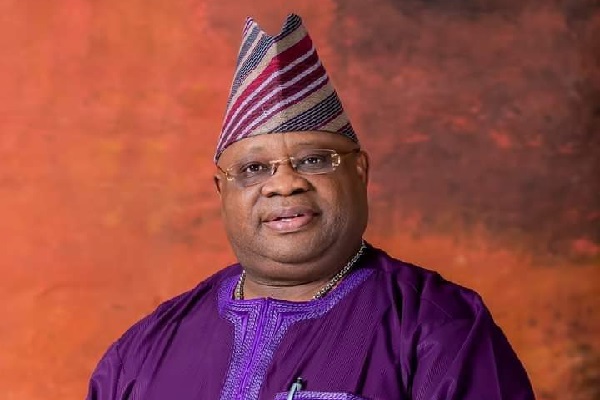
Governor Ademola Adeleke has secured a second term in office after defeating his closest challenger, Bola Oyebamiji of the All Progressives Congress (APC), in a closely watched Osun State governorship election.
The Independent National Electoral Commission (INEC) declared Adeleke the winner early on Sunday after the collation of results from all 30 local government areas. The Accord Party candidate polled 511,067 votes, defeating Oyebamiji, who scored 444,815 votes, by 66,252 votes. African Democratic Congress (ADC) candidate Najeem Salaam came a distant third with 17,180 votes.
But beyond the headline figures, the election was decided by a combination of Adeleke’s commanding margins in key strongholds, his geographical spread, incumbency advantage and the fragmentation of the opposition vote.
1. Adeleke won where the numbers mattered most
The most decisive factor was not simply that Adeleke won 19 LGAs to Oyebamiji’s 11. It was the size of the margins he accumulated in some of those victories.
Nowhere was this more evident than in Ede, Adeleke’s political stronghold.
In Ede North, Accord scored 35,427 votes against APC’s 10,283, giving Adeleke a staggering 25,144 vote advantage.
FG Opens Recruitment Into Nigeria Agricultural Quarantine Service — How to Apply
Tinubu Urged to Nominate Abiola’s widow for UN Secretary-General
In neighbouring Ede South, Adeleke polled 26,188 votes against Oyebamiji’s 6,219, another 19,969 vote margin.
Together, the two Ede LGAs delivered Adeleke 61,615 votes, compared with just 16,502 for the APC, giving him a net advantage of 45,113 votes from two councils alone.
That cushion proved extremely difficult for the APC to overturn elsewhere.
2. He turned his home base into an electoral fortress
Adeleke’s dominance in Ede was expected, but the scale of the victory was critical.
The Osun West Senatorial District had been identified before the election as one of the decisive battlegrounds. Adeleke, Oyebamiji and Salaam all hailed from the district, creating the possibility of a three way division of votes.
Instead, Adeleke maintained a powerful hold on several councils in the district.
He won Ede North, Ede South, Egbedore, Iwo, Ayedaade, Ayedire and Ejigbo, while the APC took Irewole, Isokan and Ola Oluwa.
That meant the governor not only protected his home territory but also prevented Oyebamiji from converting the district into the springboard needed to close the statewide gap.
3. Adeleke remained competitive in major urban centres
Another important feature of the result was Adeleke’s ability to win outside his immediate political base.
In Osogbo, the state capital, Accord secured 36,480 votes against APC’s 30,474, giving Adeleke a 6,006 vote advantage.
The result mattered because Osogbo was also one of the areas where the APC remained highly competitive.
Rather than merely scraping through, Adeleke accumulated a meaningful margin in the state capital.
4. The Ife axis broadened his lead
Adeleke also performed strongly across the Ife axis.
He won:
- Ife East: 27,201 to APC’s 18,600
- Ife Central: 21,171 to 15,913
- Ife North: 13,879 to 9,613
The three councils therefore delivered another substantial block of votes for the incumbent, with Accord winning each of them.
This geographical spread was important because it meant Adeleke was not dependent solely on Ede and Osun West to win the election.
5. He built a broad statewide coalition
Adeleke’s 19 winning LGAs were spread across different parts of Osun rather than concentrated in one senatorial district.
He won councils including Ede North, Ede South, Egbedore, Iwo, Ejigbo, Osogbo, Ife East, Ife Central, Ife North, Ilesa West, Oriade, Ifelodun, Odo Otin, Orolu, Ifedayo, Ila, Ayedire, Ayedaade and Boluwaduro.
That spread ultimately mattered more than the APC’s ability to dominate several of its own strongholds.
6. APC won big in some places, but not enough places
Oyebamiji was far from a weak challenger.
The APC won 11 LGAs, including Irewole, Isokan, Olorunda, Atakumosa East, Atakumosa West, Ilesa East, Boripe, Irepodun, Obokun, Ola Oluwa and Ife South.
Some of those victories were substantial.
In Irewole, Oyebamiji scored 29,972 votes against Adeleke’s 10,934, giving the APC a 19,038 vote advantage.
In Boripe, APC won 19,963 to Accord’s 12,448.
The problem for Oyebamiji was that these victories could not compensate for the much larger margins Adeleke accumulated in Ede and several other councils.
As the final figures showed, the APC won 11 LGAs but still finished 66,252 votes behind statewide.
7. Adeleke’s 2026 performance was stronger than his 2022 victory
The scale of Adeleke’s victory becomes clearer when compared with his first election in 2022.
According to an analysis by BusinessDay, Adeleke increased his vote total from 403,371 in 2022 to 511,067 in 2026, an increase of 107,696 votes.
He also increased his LGA tally from 17 to 19, while the APC’s tally fell from 13 LGAs in 2022 to 11.
Most significantly, his winning margin more than doubled, from 28,344 votes in 2022 to 66,252 votes in 2026.
That suggests the governor did not merely scrape through for another term. Numerically, he expanded his electoral base.
8. Incumbency worked in Adeleke’s favour
Adeleke entered the contest with the advantages that come with occupying the Government House.
Pre election analysis identified his visibility through capital projects and welfare initiatives as an advantage, while noting that he faced significant structural disadvantages because the APC controlled many local government structures.
The fact that he still won 19 LGAs despite those challenges indicates that the APC’s control of local government structures did not translate into sufficient votes at the ballot box.
2027: Degrees, Jobs, NYSC—Inside Tinubu, Atiku and Obi’s INEC Documents
Dangote Refinery IPO: When Africa Begins to Own What It Builds
9. His populist political style connected with sections of the electorate
Adeleke’s political style also appears to have played a role.
Pre election reporting noted that his accessible, populist and media friendly style resonated particularly with sections of the youth and civil servants, while his public dancing and informal persona had helped build a distinctive political identity.
His campaign also projected confidence rather than defensiveness.
Days before the election, Adeleke famously declared: “I am a bulldozer”, insisting that he was not intimidated by federal influence or governors supporting Oyebamiji.
The result gave that campaign rhetoric a powerful numerical ending.
10. The opposition failed to consolidate its votes
The presence of Najeem Salaam of the ADC also mattered.
Although Salaam finished a distant third with 17,180 votes, his candidacy meant the election was not a straight two way contest from the beginning.
Pre election analysis had identified the possibility that the ADC could act as a spoiler by taking votes from either of the two leading parties.
In the final tally, however, neither Accord nor APC was seriously threatened by the ADC. The contest remained overwhelmingly dominated by Adeleke and Oyebamiji.
The decisive numbers
Ultimately, the Osun election was a lesson in electoral arithmetic.
Adeleke did not win every battleground. He lost 11 LGAs. The APC also produced formidable numbers in several of its strongholds.
But Adeleke won 19 LGAs, amassed 511,067 votes and created large enough margins in critical areas to make the APC’s victories insufficient to catch him.
Accord — 511,067
APC — 444,815
ADC — 17,180
Adeleke’s winning margin — 66,252 votes
LGAs won — Adeleke 19, Oyebamiji 11
In the end, Adeleke did not defeat Oyebamiji simply by winning more LGAs. He defeated him by winning the right LGAs, by wider margins, while maintaining enough support across the rest of the state to build a statewide coalition that the APC could not overturn.
And perhaps the most striking statistic is this: compared with 2022, Adeleke added more than 100,000 votes to his tally and more than doubled his winning margin.
That makes his 2026 re election not merely a repeat victory, but a significantly stronger electoral mandate.