
World football governing body FIFA has formally accepted the resignation of Nigeria Football Federation President Ibrahim Musa Gusau and other principal officers of the federation as consultations begin on a comprehensive reform roadmap for Nigerian football.
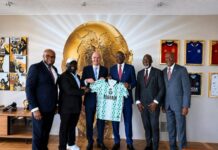
The development was disclosed on Tuesday by the NFF Interim Deputy General Secretary, Dr Ademola Olajire, following a high level meeting involving FIFA, the Confederation of African Football, the National Sports Commission and the NFF administration at FIFA House in Zurich, Switzerland.
According to Olajire, FIFA also agreed to continue engaging the Nigerian Government, NFF and CAF to fine tune a framework for short, medium and long term reforms in the administration and development of Nigerian football.
Dangote Refinery to stop selling Petrol to Importing Marketers Over Quality Concerns
FG Opens Recruitment Into Nigeria Agricultural Quarantine Service — How to Apply
The meeting resolved that the reform process should lead to the emergence of an inclusive and properly structured NFF, supported by a peaceful and stable operating environment capable of delivering improved results on and off the pitch.
“The engagements and interactions will continue to fine tune a roadmap that will ensure the delivery of the expected reforms both in the short, medium and long term, and to ensure that an inclusive new NFF emerges going forward,” Olajire said.
The development follows Gusau’s resignation last week alongside other members of the NFF Executive Committee amid growing calls for far reaching changes in the administration of Nigerian football.
The NFF has subsequently put in place an interim administrative arrangement, with Dr Emmanuel Ikpeme serving as Acting General Secretary and Olajire as Interim Deputy General Secretary.
The Zurich meeting was attended by a high powered Nigerian delegation led by NSC Chairman Shehu Dikko. The delegation included NSC Director General Bukola Olopade, former NFF President Amaju Pinnick, Ikpeme and NFF Director of Legal Services Okey Obi.
CAF was represented by its Second Vice President Kurt Okraku, while FIFA was represented by its Director of Member Associations for Africa, Gelson Fernandes.
Dikko said the engagement was necessary to ensure that the reform process complied with relevant FIFA, CAF and NFF statutes and regulations.
“There is no doubt Nigeria Football will emerge much better and properly structured after the conclusion of this process,” he said.
The development comes at a difficult period for Nigerian football, with the country facing mounting concerns over the performance of its national teams and the administration of the sport.
Nigeria’s Super Eagles missed qualification for the 2026 FIFA World Cup, while the Super Falcons failed to qualify for the 2027 Women’s World Cup, their first absence from the tournament since its inception in 1991.
Kaduna Varsity Loses Over 200 lecturers as ASUU Issues Strike Ultimatum
Chelsea Fuming as Monaco Pulls Plug on £47m Camara Deal After Deadline
Meanwhile, the NFF has dismissed reports that FIFA demanded clarification over alleged government interference in the federation’s affairs.
The federation described a purported FIFA letter circulating in sections of the media as “totally fake”, saying FIFA had already accepted the resignations of the former principal officers and members of the NFF Executive Committee.
The reform process will therefore be closely watched as FIFA, CAF, the NSC and the NFF attempt to establish a new administrative framework capable of restoring stability and improving Nigeria’s fortunes on the international stage.