…Former AfDB president meets Tinubu, reveals $7bn financing for Nigeria, backs economic reforms
Former President of the African Development Bank (AfDB), Dr Akinwumi Adesina, has declared his readiness to serve Nigeria in any capacity, insisting that his decision to return home after a decade at the continental financial institution is driven by patriotism rather than a desire for political appointment.
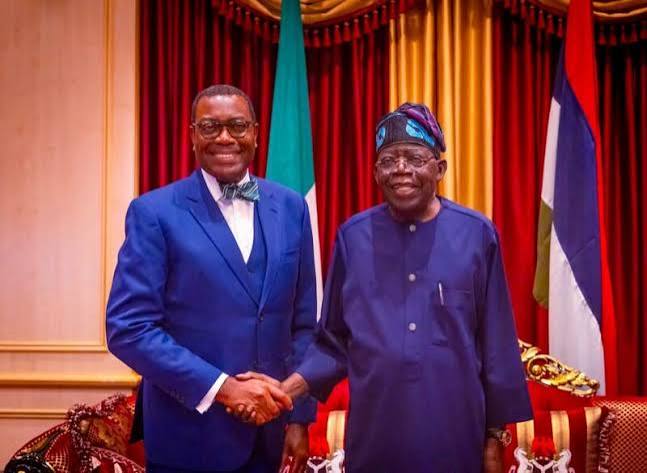
Adesina made the declaration on Tuesday after meeting President Bola Tinubu at the Presidential Villa, Abuja, where he briefed the President on his 10-year stewardship of the AfDB and the institution’s contributions to Nigeria’s development.
The former AfDB chief, who completed two five-year terms at the bank, said he considered it a personal responsibility to contribute his experience and expertise to Nigeria’s economic development.
“I’m back at home, here to help and ready to help. It’s my country. I love my country, and I’m ready to help,” he said.
Asked whether he was seeking a particular role in the Tinubu administration, Adesina dismissed suggestions that his visit was motivated by a search for government appointment.
He maintained that he was willing to contribute wherever his expertise might be needed.
Tinubu Is Pharaoh, Not Moses, He Has Impoverished Nigerians — SDP Presidential Candidate
33 Custody Deaths: Probe Panel Recommends Dismissal, Prosecution of NSCDC Officers
“Well, you know, I’m fully able to help Nigeria in any capacity. I’ve always had that. You know, my heart is always at home. And in any capacity that His Excellency feels I can help, I can help in anything.
“I’m not looking for a job. I’m not looking for anything. I’m just here to help. It’s my country. I have a duty, an obligation, and a responsibility to do so, and I will,” he declared.
Adesina explained that his meeting with Tinubu was partly intended to formally report the completion of his tenure as AfDB president and highlight the development financing extended to Nigeria under his leadership.
According to him, the bank provided approximately $7 billion in financing to Nigeria between 2015 and 2025, accounting for about 63 per cent of the $11.1 billion committed to the country since the institution began operations in Nigeria in 1971.
He said the figures demonstrated the significance of Nigeria’s development partnership with the AfDB during his administration.
Adesina disclosed that Tinubu expressed satisfaction with the bank’s achievements and its contributions to Nigeria’s development over the period.
Beyond reviewing his stewardship, the former AfDB president commended the Tinubu administration for implementing economic reforms, particularly the removal of petrol subsidy and the harmonisation of foreign exchange windows.
He described the policies as difficult but necessary measures intended to address longstanding structural weaknesses in the Nigerian economy.
According to him, the reforms are beginning to produce encouraging results, particularly in foreign exchange availability, renewed portfolio investment and moderating inflation.
Adesina observed that the foreign exchange market had become more accessible, while international portfolio investors were showing renewed interest in Nigeria.
He also pointed to the declining inflation rate as evidence of improving macroeconomic conditions, although he acknowledged that Nigerians continued to contend with high prices.
The former AfDB president further noted that Nigeria’s standing in international financial markets had improved, citing more favourable assessments by credit rating agencies.
He said some agencies had assigned stable or positive outlooks to the country, reflecting improved perceptions of its economic prospects.
Ebola Scare in Abuja: FG Traces 44 Contacts After Infected Traveller Spends Days in Hospital
ICPC Fires Officer Accused of Smuggling El-Rufai’s Wife Into Custody
However, Adesina stressed that macroeconomic stabilisation alone would not be sufficient to deliver the prosperity Nigerians expected.
He argued that the government must build on the reforms by pursuing structural economic transformation capable of stimulating productive investment, creating employment and sustaining long-term growth.
According to him, economic recovery must ultimately translate into tangible improvements in living standards and broader development opportunities for Nigerians.
Adesina said Tinubu recognised the importance of moving beyond stabilisation towards deeper economic transformation.
His remarks come after the conclusion of his decade-long leadership of the African Development Bank, during which he oversaw the institution’s financing activities and development interventions across the continent.
The former AfDB president maintained that, having completed his assignment at the continental institution, he was prepared to make his experience available to Nigeria without attaching conditions to the nature of his involvement.