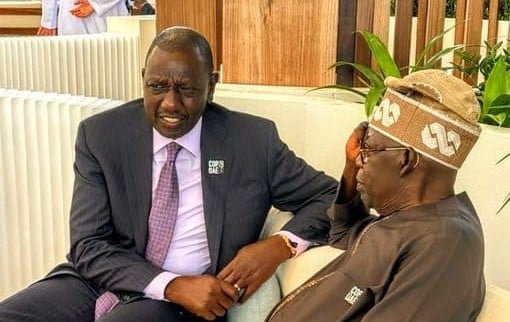
A fresh war of words is rippling across Africa after William Ruto took a swipe at Nigeria’s economy and even its English, pushing back against claims by Bola Tinubu that Nigerians are better off than citizens in other African countries.
What began as a routine policy defence has quickly spiralled into a viral, cross border debate on economic reality, national pride and perception.
How It Started
Speaking during a visit to Bayelsa State, Tinubu acknowledged the hardship caused by rising fuel prices but urged Nigerians to take a broader view.
He argued that, compared to other African nations, Nigeria’s position remains relatively stable, insisting his administration would continue efforts to ease the burden on vulnerable citizens.
“It is very important that we are honest with our people. Yes, I hear you from various angles of the economy. The fuel price is biting hard, but look around, let us thank God together, that you are better off. Listen to them in Kenya and other African countries and what they are going through. We will not look back. We will continue to fine way to ameliorate the sufferings of the vulnerable,” Tinubu had said.
Ruto’s Viral Comeback
Ruto did not let the comparison slide.
In a widely circulated response, the Kenyan leader challenged Nigeria’s economic standing, pointing to infrastructure gaps, especially in power supply, while adding a sharp, humorous jab:
Nigerians speak English so differently “you’ll need a translator.”
“Our education is good. Our English is good. We speak the best English in the world. If you listen to a Nigerian speak English, you’ll need a translator. We’ve the best human capital anywhere in the world,” Ruto said, using humour to defend his country’s standing.
The comment, though delivered with levity, has since triggered intense reactions online, with many interpreting it as both playful banter and pointed criticism.
More Than Just Banter
Beyond the humour, the exchange taps into deeper issues.
Across the continent, countries are grappling with rising fuel costs, inflation and currency pressures, much of it tied to global disruptions, including tensions affecting oil supply routes.
Nigeria, despite being Africa’s largest oil producer, continues to battle energy shortages and economic reforms that have raised living costs.
Kenya, on the other hand, has positioned itself as a services and innovation hub, often highlighting its human capital and education system.
A Battle of Perception and Reality
At its core, this is not just about English or economics.
It is about narrative.
Tinubu’s remarks reflect an attempt to frame Nigeria’s reforms as necessary and comparatively stabilising. Ruto’s response flips that narrative, questioning whether Nigerians are truly better off.
What Happens Next
Diplomatically, such exchanges rarely escalate into formal disputes, but they do shape public sentiment.
For citizens, the conversation is already moving beyond leaders, sparking debates on identity, governance and what “being better off” really means in today’s Africa.
One thing is clear.
This is no longer just a comment.
It is a continental conversation.