
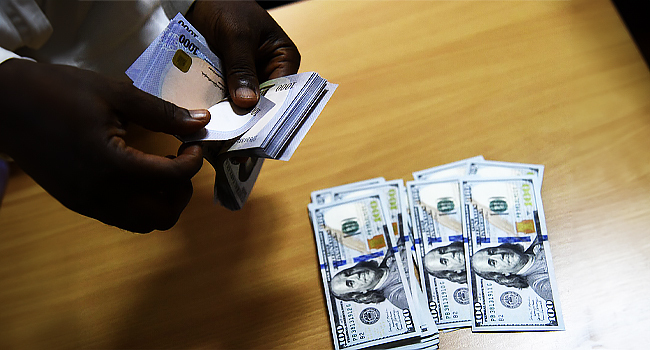
The Chairman of the Alliance for Economic Research and Ethics (AERE), Dele Oye, has warned that Nigeria’s record $4.375 billion foreign exchange market turnover in a single week should not be mistaken for evidence of a stronger or more resilient forex market.
Instead, he said the milestone exposed structural weaknesses in the country’s foreign exchange system and underscored the need for greater transparency, stronger market depth and reforms to discourage the dollarisation of the economy.
In a statement titled “What a Record FX Week Really Reveals About Nigeria’s Market,” Oye argued that while the market demonstrated its ability to process a high volume of transactions, the surge did not necessarily reflect improved liquidity, stronger external reserves or broader access to foreign exchange.
‘I Clothed Obasanjo, Fed his family, Built Alliances That Made Him President’ – Atiku
2027: Degrees, Jobs, NYSC—Inside Tinubu, Atiku and Obi’s INEC Documents
According to him, unusually high trading volumes can sometimes result from a small number of large transactions rather than sustained improvements in market fundamentals.
“Nigeria’s foreign exchange market recorded total spot and derivatives turnover of $4.375 billion in the week ended July 24, 2026, the first weekly reading above $4 billion this year. The figure was 83.38 per cent higher than the $2.386 billion reported in the preceding week,” he said.
“The headline deserves attention. Yet it should not be read too quickly as proof that Nigeria’s FX market has become deep, stable or broadly accessible.”
Oye noted that the latest figure followed weeks of significant volatility, with turnover fluctuating from $3.053 billion to $1.631 billion, before recovering to $2.386 billion and eventually reaching the record $4.375 billion.
He said the sharp swings highlighted the difference between high transaction velocity and genuine market resilience.
“A large amount of foreign exchange may be changing hands without creating a market that is sufficiently broad, predictable or shock absorbing for manufacturers, small businesses, households and long-term investors,” he said.
The economist also pointed to the sharp increase in forward contracts as evidence that market participants were seeking protection against future exchange rate movements.
According to him, forward contracts rose by 333.59 per cent, from $14.5 million to $62.87 million, during the period.
“When spot market activity and forward hedging rise together, it is consistent with participants seeking both immediate dollars and protection against future exchange rate changes,” he explained.
Although forward contracts accounted for only 1.44 per cent of total turnover, Oye said the trend suggested the record trading week involved more than routine commercial transactions.
He also warned against the growing use of the US dollar for domestic transactions, saying it poses a long-term threat to the naira.
Referring to Dangote Petroleum Refinery’s temporary decision in July to price petrol, diesel and aviation fuel in dollars before reversing the policy about a week later, Oye said the episode demonstrated how decisions by a few major companies could significantly influence Nigeria’s foreign exchange market.
“The timing makes a contribution to the turnover surge plausible. It does not establish a full causal explanation, but it demonstrates a structural exposure: when a major domestic firm changes its pricing or procurement behaviour, the FX market can face an abrupt and unusually large demand shock,” he said.
He maintained that Nigeria must resist the gradual dollarisation of its economy.
“The naira must remain the normal currency for domestic pricing and settlement, particularly in essential sectors. If domestic producers increasingly price local goods in dollars, the country weakens the naira’s role as a unit of account and medium of exchange while transferring currency risk to households and smaller businesses,” Oye stated.
Why the Supreme Court Ordered Lawyers to Stop Calling Themselves ‘Barrister
UNIJOS Suspends Academic Activities Over Rising Security Concerns
He called on the Central Bank of Nigeria and FMDQ to provide more detailed information on major foreign exchange transactions to improve transparency, reduce speculation and strengthen investor confidence.
Oye also urged policymakers to prioritise long-term investments in agriculture, manufacturing, technology and infrastructure instead of relying heavily on short-term portfolio inflows.
“The test of a mature FX market is not whether it can produce one historic weekly number. The test is whether it can provide transparent price discovery, credible hedging, stable access for productive users and sufficient depth to absorb large shocks without transferring the cost to the real economy,” he said.