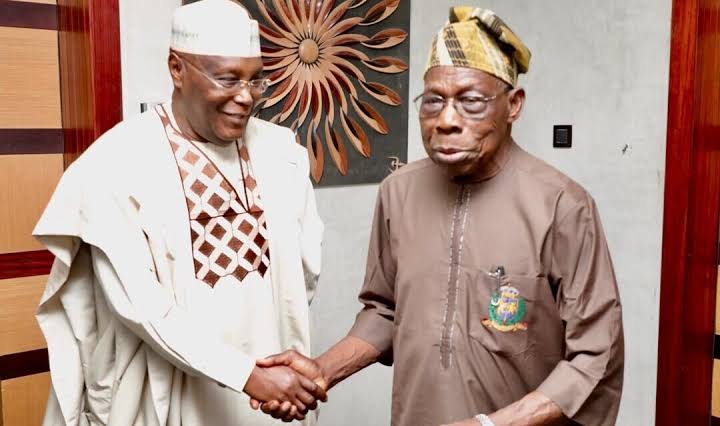
Former Vice President and African Democratic Congress (ADC) presidential candidate, Atiku Abubakar, has launched a blistering response to former President Olusegun Obasanjo, declaring that he wears the former president’s resentment “as a badge of honour” because he chose Nigeria and constitutional democracy over personal loyalty.
In a statement issued on Saturday by his Senior Special Assistant on Public Communication, Phrank Shaibu, Atiku said Obasanjo’s latest public remarks reflected “the disposition of a man who has allowed personal resentment to cloud historical truth.”
According to Atiku, the root of Obasanjo’s hostility towards him was his refusal to support the former president’s controversial third term agenda while they served in office.
FG Opens Recruitment Into Nigeria Agricultural Quarantine Service — How to Apply
Tinubu Dissolves Presidential Committee Responsible for Sale, Lease of FG Properties
“I am proud that I stood against the third-term agenda. I am proud that I stood by the Constitution of the Federal Republic of Nigeria. I have no apology whatsoever for frustrating every attempt to subvert our democracy for personal ambition.
“If Chief Obasanjo’s bitterness stems from my refusal to support an unconstitutional third term, then I wear that resentment as a badge of honour. No individual, regardless of his status or accomplishments, is bigger than the Federal Republic of Nigeria. The Constitution is supreme, and I chose Nigeria over personal loyalty,” Atiku stated.
The former Vice President insisted that the battle against the third-term bid was a victory for Nigeria’s democracy and not a personal dispute between him and Obasanjo.
He argued that history had already delivered its verdict and accused the former president of attempting to rewrite events.
Atiku also used the opportunity to recount his role in Obasanjo’s political comeback, claiming he stood by the former military ruler during his incarceration and played a critical part in his emergence as president in 1999.
“History records that while Chief Obasanjo was in prison, I stood firmly by him. I supported his family, worked tirelessly with other patriots for his release and never wavered in my belief that he deserved his freedom.
“When he eventually regained his freedom, he had little to his name. I received him, clothed him, ensured he was properly cared for and extended every support necessary to help him regain his footing.
“Beyond that, I mobilised political structures, built alliances and made enormous personal and political sacrifices that culminated in his emergence as President of the Federal Republic of Nigeria,” Atiku said.
Despite the claims, Atiku maintained that he had no regrets over supporting Obasanjo.
“Do I regret helping Chief Obasanjo? Absolutely not. When God gives you the opportunity to lift another human being, you do so without expecting repayment. Acts of kindness are matters of conscience, not commercial transactions,” he added.
The former Vice President, however, cautioned that gratitude should not be replaced with attempts to distort history.
“If the true history of Chief Obasanjo’s political journey is ever written, free from selective recollection and personal bitterness, Atiku Abubakar will feature prominently as one of those whom God used to change the course of his life and political career,” he said.
Atiku further argued that rather than dwelling on old political grievances, national leaders should focus on Nigeria’s pressing challenges, including insecurity, unemployment and economic hardship.
“The 2027 election should be about rebuilding Nigeria, restoring security, reviving the economy and giving hope to the next generation—not reopening old political wounds,” he said.
While noting that he had exercised restraint out of respect for Obasanjo and the office he once occupied, Atiku said he would no longer remain silent in the face of repeated distortions.
The Real Reason Aliko Dangote Is Giving Away a Third of His Fortune – Children
US Condemns Massacre of Pastor’s Family in Plateau, Demands Justice
“There comes a point when silence in the face of repeated distortions of history ceases to be a virtue.
“Chief Obasanjo is entitled to his opinions. He is entitled to his personal grievances. What he is not entitled to are his own facts,” Atiku declared.
He concluded by insisting that history, rather than personal bitterness, would ultimately determine the truth.
“History is stubborn. It cannot be rewritten by bitterness, nor erased by repeated falsehoods. In the end, history will render its verdict—and so will the Nigerian people,” he said.